Target Selection
Not sure if your target is druggable, or where to hit it?
Our target selection tools integrate proprietary AI workflows with physics-based validation for superior prediction quality. We predict and prioritize targets, identify and rank binding sites, and assess which pockets are worth pursuing, paving the way for hit identification.
- Target novelty assessment with literature mining and Yggdrasil, our knowledge graph integrating 40+ databases
- AI-based target prediction and prioritization
- Binding site detection with AI, geometry- and physics-based methods and PELE® Monte Carlo sampling, including allosteric and cryptic pockets
- Druggability and modality assessment: small molecule, peptide, degrader, biologic or RNA/DNA-based
- Custom models of specific states from state-of-the-art AI structure prediction, such as active or inactive GPCR conformations
- Physics-based validation of predicted structures and binding sites
- Disease-mechanism studies of patient mutations, as for the ClC-5 transporter in the rare kidney disorder Dent’s disease (PNAS Nexus, 2025)
- Reverse docking and cysteine accessibility assessment for covalent inhibitors
- Tractability reports that score and rank your targets
Hit Finding
Looking for novel, high-quality hits?
ALScreen, our proprietary hit-finding platform, pairs the speed of AI with the accuracy of physics-based modeling, so we explore more chemical space, faster and at lower cost, and deliver hits worth pursuing.
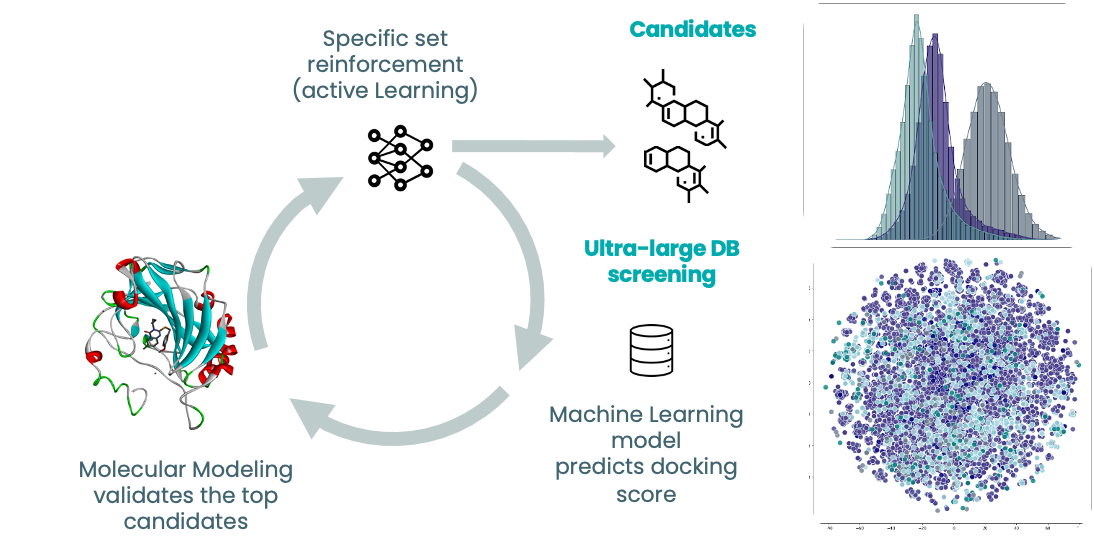
- AI- and physics-based virtual screening of focused and ultra-large libraries, up to 200 billion molecules in a few weeks
- Active learning that improves the hit list round after round
- Generative design with ALGen, with no need for known binders
- State-of-the-art docking methods, refined with PELE® induced fit
- Pharmacophore, covalent and fragment-based screening
- Polypharmacology: screening against several targets at once
- Validated in a virtual screening campaign with Almirall that delivered structurally novel hits (WIREs Computational Molecular Science, 2023)
- PELE® singled out in GSK’s CSAR blind docking competition for its robust performance across all three targets (International Journal of Molecular Sciences, 2022)
Hit to Lead
Ready to turn your hits into leads?
We expand and refine your hits into potent, selective lead series, combining AI-driven de novo design with physics-based tools such as Frag-PELE fragment growing and free energy predictions to prioritize the compounds worth making.
- De novo small-molecule generation
- Congeneric series ranking with MCS docking and PELE® induced fit
- Scaffold hopping and fragment growing with Frag-PELE and a 260,000-fragment library
- Similarity search and bioisostere replacement
- Free energy predictions (FEP) with cutting-edge proprietary and open-source methods
- Pharmacophore and target flexibility modeling
- Reusable simulation data: our President Modesto Orozco led 100+ scientists in defining FAIR standards for molecular dynamics, so past simulations can speed up new projects (Nature Methods, 2025)
- Dual inhibitor design and polypharmacology
- Covalent binder development
Lead Optimization
Need to turn a promising lead into a candidate?
We fine-tune potency, selectivity and ADMET properties in parallel, combining 3D machine learning models with physics-based free energy predictions to guide every design cycle, so fewer compounds need to be made and tested on the way to your candidate.
- 3D machine learning models
- Rational and medicinal chemistry design
- Free energy predictions
- In silico ADMET prediction with graph neural networks, covering absorption, CYP metabolism, hERG, blood–brain barrier and toxicity, each with a confidence score
- Multi-parameter optimization of potency, selectivity and ADMET
Proximity Inducers
Dealing with an undruggable target? See what we offer in proximity induction: molecular glues, degraders and beyond.
We offer a custom-tailored discovery pipeline for molecular glues and PROTACs, powered by our proprietary TPD-Suite®, GluePELE and PELETAC platforms.
- Molecular glue (MG) design for a given binary complex
- Molecular glue screening of commercial libraries
- E3 ligase pairing for a given protein of interest (POI), against 400+ ready-to-dock ligases
- Binary/ternary complex prediction, combining protein–protein docking with PELE® flexible refinement
- PROTAC docking workflows benchmarked with Almirall on 43 experimentally solved ternary complexes (Journal of Chemical Information and Modeling, 2025)
- Proprietary E3 ligase-warhead library